§ 01 · Robotics · Club · Since 2019
SofaBot
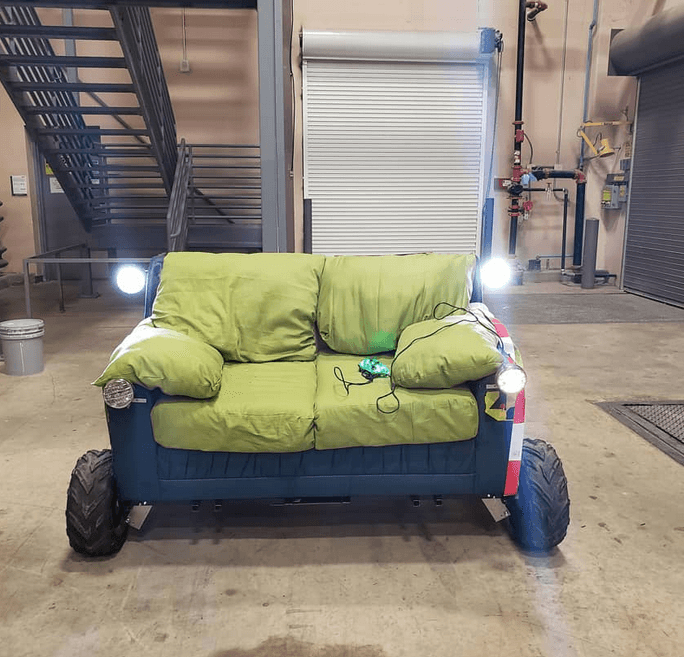
A driveable sofa, built from a free couch and a stripped-for-parts go-kart.
UNT Robotics Club project, started fall 2019. Gas-to-electric motor conversion, two car batteries, motor controllers, Raspberry Pi, Xbox controller. Team of 5, then 4. My contribution: electrical wiring and most of the physical build.
§ 02 - The build
The build
Started in fall 2019 as a UNT Robotics Club project after someone in the club joked about driving a couch around campus. A few of us took the joke seriously enough to find a free sofa on a local listing and a cheap go-kart, and the next day we started taking them apart.
The plan was simple, the execution less so. We converted the gas-powered go-kart's drivetrain to electric, mounted the motors and motor controllers on the underside of the sofa, wired in two car batteries for power, and ran control through a Raspberry Pi listening to an Xbox controller. The first few attempts cost us a Raspberry Pi and a couple of motor controllers as we worked out the voltage tolerances by trial and error. Once the electronics survived being powered on, the rest came together: the sofa drove, on tank controls.
Team of 5 at the start, settling to 4 for most of the project's life. I owned the electrical wiring and most of the physical labor; the code was largely open-source motor-control work modified to fit. Proper steering (front-wheel articulation rather than tank-style) was the aspirational next step. We never got there. Then COVID hit in 2020, and the project went on hard pause.
§ 03 - Outcome
Outcome
SofaBot worked. After the voltage-tolerance education, the sofa drove well enough that we did a test run through campus one day. Someone filmed it, the video reached the university, and a few weeks later we were invited to drive SofaBot in the UNT homecoming parade in fall 2019. The sofa drove, in a parade.
What I took from the project, looking back, was the trial-and-error voltage education. We burned through a Raspberry Pi and a couple of motor controllers learning what the system could and couldn't tolerate. That kind of learning doesn't transfer cleanly into a textbook chapter, but it builds the kind of intuition you only get from killing components in real hardware. I think about that intuition when I'm specifying margins on anything new.
The project went on hard pause for COVID in 2020 and has been on slow-burner status since 2022, mostly the proper-steering work. Most of us have other priorities now (jobs, family, the regular set), so SofaBot is on a roughly monthly cadence, progressing when we have the time.